The Figures
Thoth

Thoth (Egyptian Djehuty) was Egypt's god of writing, reckoning and secret knowledge, worshipped for some three thousand years at Hermopolis. When Greek settlers identified him with their Hermes, his priestly epithet "great, great, great" became the Greek Trismegistos — making Thoth the Egyptian root of Hermes Trismegistus and of the entire Hermetic tradition.

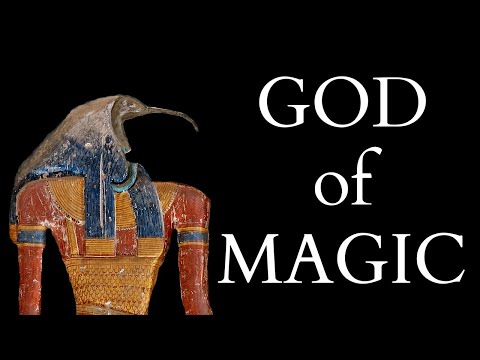
Before there was a Hermes Trismegistus, there was a god with an ibis’s head and a scribe’s palette. Thoth — Egyptian Djehuty — was the divine inventor of hieroglyphic writing, patron of scribes, measurer of time, and the gods’ own secretary. In the judgment scene of the Book of the Dead, while the heart is weighed against the feather of Maat, Thoth stands at the balance and records the verdict: “scribe of the gods” was a job description before it was a metaphor.
From Khemenu to Hermopolis
His cult centre was Khemenu in Middle Egypt, a hub of scribal training and priestly scholarship. Greek settlers, recognising their own divine messenger in him, renamed the town Hermopolis — “city of Hermes.” The identification is older than the Ptolemies: Plato’s Phaedrus (c. 370 BCE) already retells the Egyptian story of “Theuth,” inventor of letters, debating whether writing is a remedy for memory or a poison to it — the oldest surviving argument about a new information technology.
Great, great, great
Temple inscriptions piled up Thoth’s epithet: “the great, the great, the great.” Demotic documents of the ibis cult call him “the three times great” by 172 BCE; in Greek this became trismegistos — thrice-greatest. That single translated epithet, carried by bilingual Egyptian priests, is the bridge from ibis-headed god to the sage credited with the Corpus Hermeticum — the story told in full at Path step 02 and on the card for Hermes Trismegistus.
The real Book of Thoth
A genuine demotic Book of Thoth exists: a master–disciple dialogue on scribal and temple knowledge, reconstructed from over forty Graeco-Roman papyri (Jasnow & Zauzich, 2005). Its form is the closest Egyptian-language parallel to the Hermetic dialogues — strong evidence that Hermetic literature has native priestly roots, not just Greek convention.
What Thoth was not
He was not an Atlantean priest-king, and he did not engrave emerald tablets 36,000 years ago. That story was invented around 1939 by “Maurice Doreal,” drawing on Theosophy and Lovecraft’s pulp fiction; no Egyptologist, papyrus or artifact supports it — and it has nothing to do with the medieval Emerald Tablet either. The documented Thoth — three millennia of cult, millions of mummified ibises at Saqqara and Tuna el-Gebel, a god of writing who became an author — needs no Atlantis.
| Egyptian name | Djehuty (ḏḥwty); Greek Thōth |
|---|---|
| Cult centre | Khemenu — renamed Hermopolis Magna by the Greeks |
| Sacred animals | The ibis and the baboon |
| Role | God of writing and reckoning; scribe of the gods at the weighing of the heart |
| Epithet | "Great, great, great" — the root of the Greek Trismegistos |
| Why he matters | The Egyptian half of Hermes Trismegistus — and of this whole tradition |
Fair questions
Is Thoth the same as Hermes Trismegistus?
Not the same, but the source: Greeks in Egypt identified Thoth with Hermes, and Thoth's epithet "three times great" became Trismegistos. Hermes Trismegistus is the fused Greco-Egyptian figure that grew from that identification.
Did Thoth write the Emerald Tablets of Atlantis?
No. The "Emerald Tablets of Thoth-the-Atlantean" is a 20th-century text invented by Maurice Doreal (c. 1939), built from Theosophy and Lovecraft's fiction. It is unrelated to ancient Egypt and to the medieval Emerald Tablet.
What was Thoth the god of?
Writing, wisdom and reckoning: inventor of hieroglyphs, patron of scribes, measurer of time, lunar deity, and recorder at the judgment of the dead.
Listen & watch
Sources & further reading
- Martin A. Stadler, "Thoth," UCLA Encyclopedia of Egyptology (2012).
- Garth Fowden, The Egyptian Hermes (Cambridge UP, 1986).
- Richard Jasnow & Karl-Theodor Zauzich, The Ancient Egyptian Book of Thoth (Harrassowitz, 2005).
- Research dossier: thoth.md §1–9.