The Texts
The Emerald Tablet

No emerald, no Egypt, no Greek original. The most famous “ancient” text in esotericism is first attested in an Arabic book of the 8th–9th century — and its most quoted line is a 19th-century paraphrase.
A dozen cryptic sentences, said to be carved on emerald by Hermes himself and found clutched in his mummified hands. That’s the legend. The document trail says something better.
Where it actually comes from
The Tablet’s oldest known appearance is inside an Arabic work, the Kitab sirr al-khaliqa (“Book of the Secret of Creation”), attributed to pseudo-Apollonius of Tyana — Balinas in Arabic. Scholarly datings of that work cluster in the 8th to early 9th century CE. No Greek original has ever surfaced. From the Arabic world it entered Latin Europe by at least three separate routes in the 12th–13th centuries and became the founding text of Western alchemy.
What the famous line really says
The Latin vulgate does not say “as above, so below”. It offers a working simile with a purpose clause — that what is below is like what is above, and the reverse, for accomplishing the miracles of the one thing. It’s an operative claim about how transformation works, not a cosmic slogan. The tidy epigram we all know was popularised in the era of Blavatsky. (Manuscript tradition varies on the exact Latin wording — our step 06 will print the critical text side by side.)
Newton’s copy
Among Isaac Newton’s alchemical papers survives his own English translation of the Tablet with commentary (Keynes MS 28, King’s College, Cambridge — digitised and readable online). For Newton the “one thing” was philosophical mercury: laboratory language, not mysticism. The father of physics, reading the Tablet as a chemist.
Why the true story is better
A fake pedigree gives you a slogan. The real transmission — Egypt remembered in Arabic, translated in Toledo, obsessed over by Newton — gives you a thousand-year relay of people who believed matter had a grammar and meant to learn it.
| First attested | Kitab sirr al-khaliqa (pseudo-Apollonius/Balinas), c. 750–833 CE |
|---|---|
| Greek original | None known |
| Latin transmission | Three routes, 12th–13th c. |
| Newton's manuscript | Keynes MS 28, King's College Cambridge (1680s–90s, dating per Dobbs) |
| Famous epigram | 19th-century condensation of the Latin simile |
Fair questions
Did a physical emerald tablet ever exist?
There is no evidence of one. The 'discovery in a tomb' story is a literary topos — a standard way ancient and medieval texts claimed authority.
Is it part of the Corpus Hermeticum?
No. It travels under Hermes' name but belongs to the Arabic-Latin alchemical tradition, centuries later.
So is 'as above, so below' wrong?
It's a compression. The idea of correspondence is genuinely Hermetic; the slogan's wording and its Instagram meaning are modern.
Listen & watch
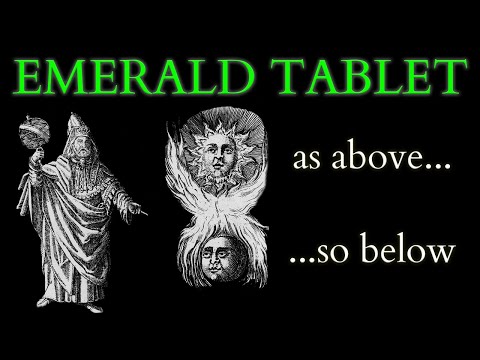

Avoid audio of Doreal’s “Emerald Tablets of Thoth” — a 1930s channeled work unrelated to the historical Tablet.
Sources & further reading
- Julius Ruska, Tabula Smaragdina (1926) — foundational study.
- Kevin van Bladel, The Arabic Hermes (2009).
- The Newton Project / Cambridge Digital Library: Keynes MS 28.
- Research dossier: emerald-tablet-arabic.md (full dating debate and transmission map).
- Steele & Singer, “The Emerald Table” (1928), full text at PubMed Central — the critical edition we quote.